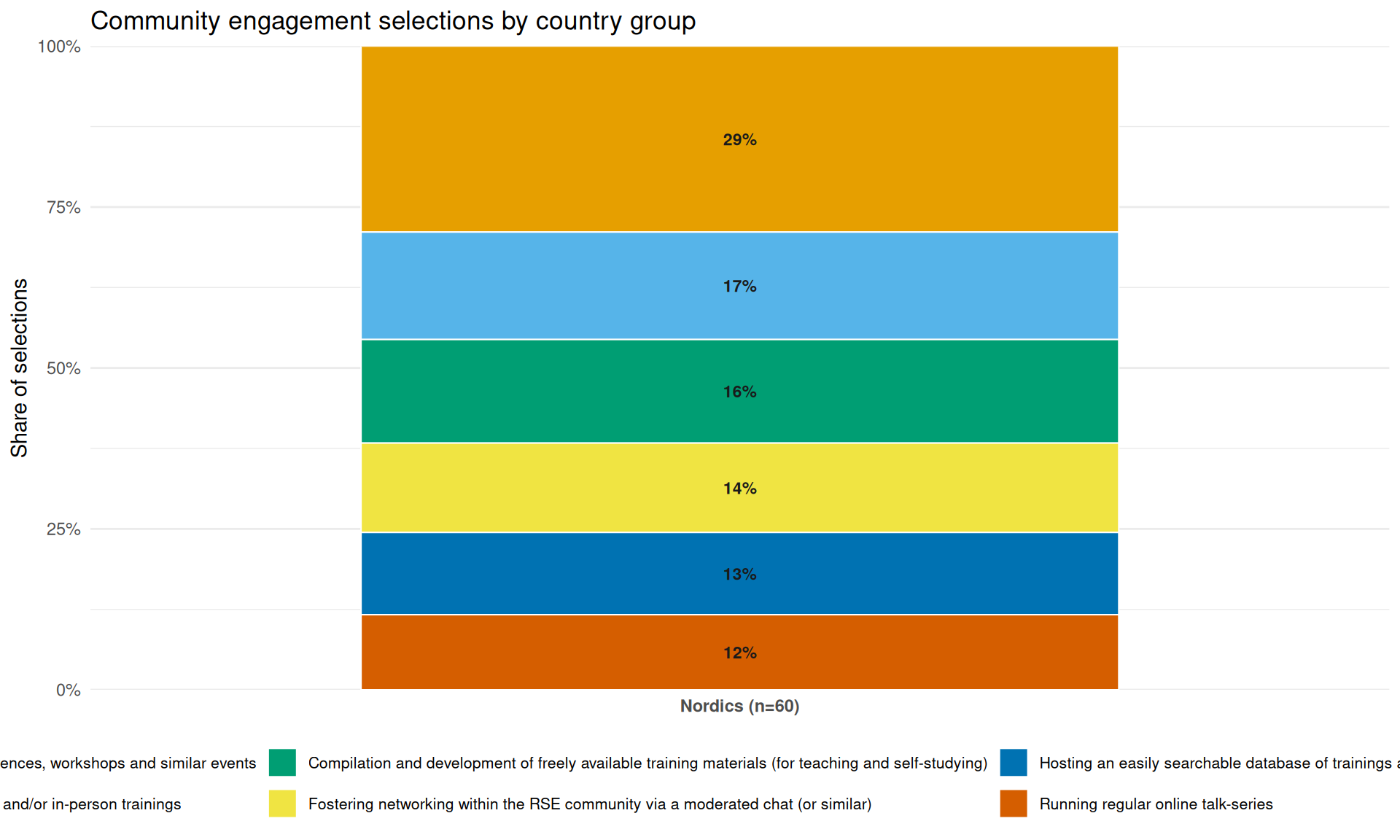
| Community engagement (Nordics) | ||
| Total respondents: 60 | ||
| Category | Respondents (n) | Percentage (%) |
|---|---|---|
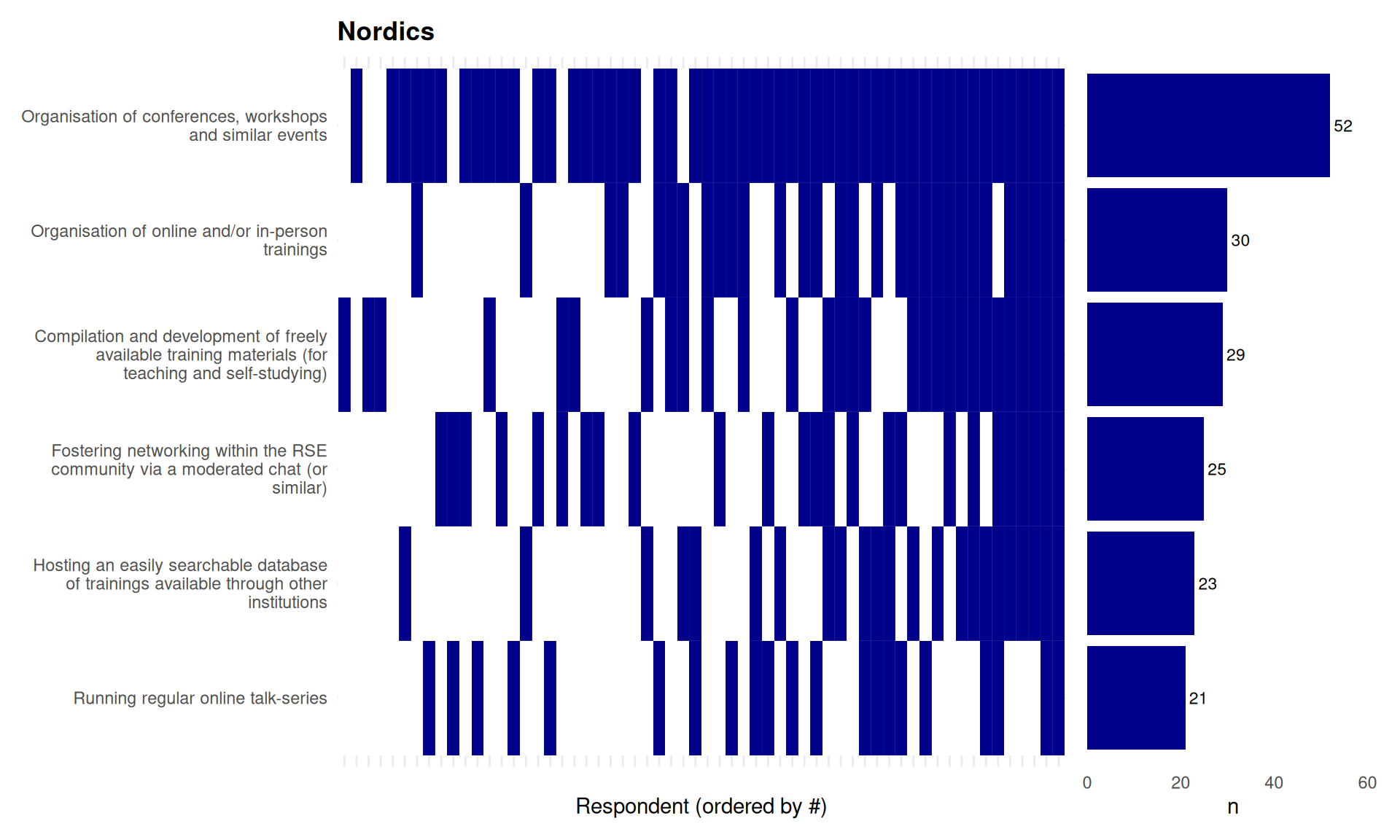
| Organisation of conferences, workshops and similar events | 52 | 86.7% |
| Organisation of online and/or in-person trainings | 30 | 50.0% |
| Compilation and development of freely available training materials (for teaching and self-studying) | 29 | 48.3% |
| Fostering networking within the RSE community via a moderated chat (or similar) | 25 | 41.7% |
| Hosting an easily searchable database of trainings available through other institutions | 23 | 38.3% |
| Running regular online talk-series | 21 | 35.0% |
14 How could Nordic-RSE or a potential Nordic research software institute foster community engagement and knowledge transfer?
14.1 Nordics
14.1.1 Descriptive Statistics
14.1.2 Free-text responses
| Nordic RSE - Community [Others] | ||
| Response Category | Frequency (n) | Percentage (%) |
|---|---|---|
| avoid sections) | 1 | 14.3% |
| example agents.md file (including must-have | 1 | 14.3% |
| good-to-have | 1 | 14.3% |
| guest in other academic conferences and workshop which are not strictly about rse | 1 | 14.3% |
| indentify a person involved in the politics and administration of each university to affect budget and planning decisions about rse development | 1 | 14.3% |
| political work at the level of institutions; policy work | 1 | 14.3% |
| provide model/agent friendly (availability/format) better practices materials | 1 | 14.3% |
The raw-to-category allocation table for this question is in Appendix B.
14.1.3 Statistics by age group
| Community engagement by age group (Nordics) | ||||||||
| Total respondents with age reported: 59. Rows are ranked separately within each age group by respondent count. | ||||||||
Below 35 (n=19)
|
35-45 (n=27)
|
45+ (n=13)
|
||||||
|---|---|---|---|---|---|---|---|---|
| Category | Respondents (n) | Percentage (%) | Category | Respondents (n) | Percentage (%) | Category | Respondents (n) | Percentage (%) |
| Organisation of conferences, workshops and similar events | 17 | 89.5% | Organisation of conferences, workshops and similar events | 21 | 77.8% | Organisation of conferences, workshops and similar events | 13 | 100.0% |
| Compilation and development of freely available training materials (for teaching and self-studying) | 13 | 68.4% | Organisation of online and/or in-person trainings | 16 | 59.3% | Fostering networking within the RSE community via a moderated chat (or similar) | 8 | 61.5% |
| Fostering networking within the RSE community via a moderated chat (or similar) | 8 | 42.1% | Compilation and development of freely available training materials (for teaching and self-studying) | 12 | 44.4% | Hosting an easily searchable database of trainings available through other institutions | 7 | 53.8% |
| Organisation of online and/or in-person trainings | 8 | 42.1% | Running regular online talk-series | 11 | 40.7% | Running regular online talk-series | 6 | 46.2% |
| Hosting an easily searchable database of trainings available through other institutions | 6 | 31.6% | Hosting an easily searchable database of trainings available through other institutions | 10 | 37.0% | Organisation of online and/or in-person trainings | 5 | 38.5% |
| Running regular online talk-series | 4 | 21.1% | Fostering networking within the RSE community via a moderated chat (or similar) | 9 | 33.3% | Compilation and development of freely available training materials (for teaching and self-studying) | 4 | 30.8% |
14.2 Within Nordics
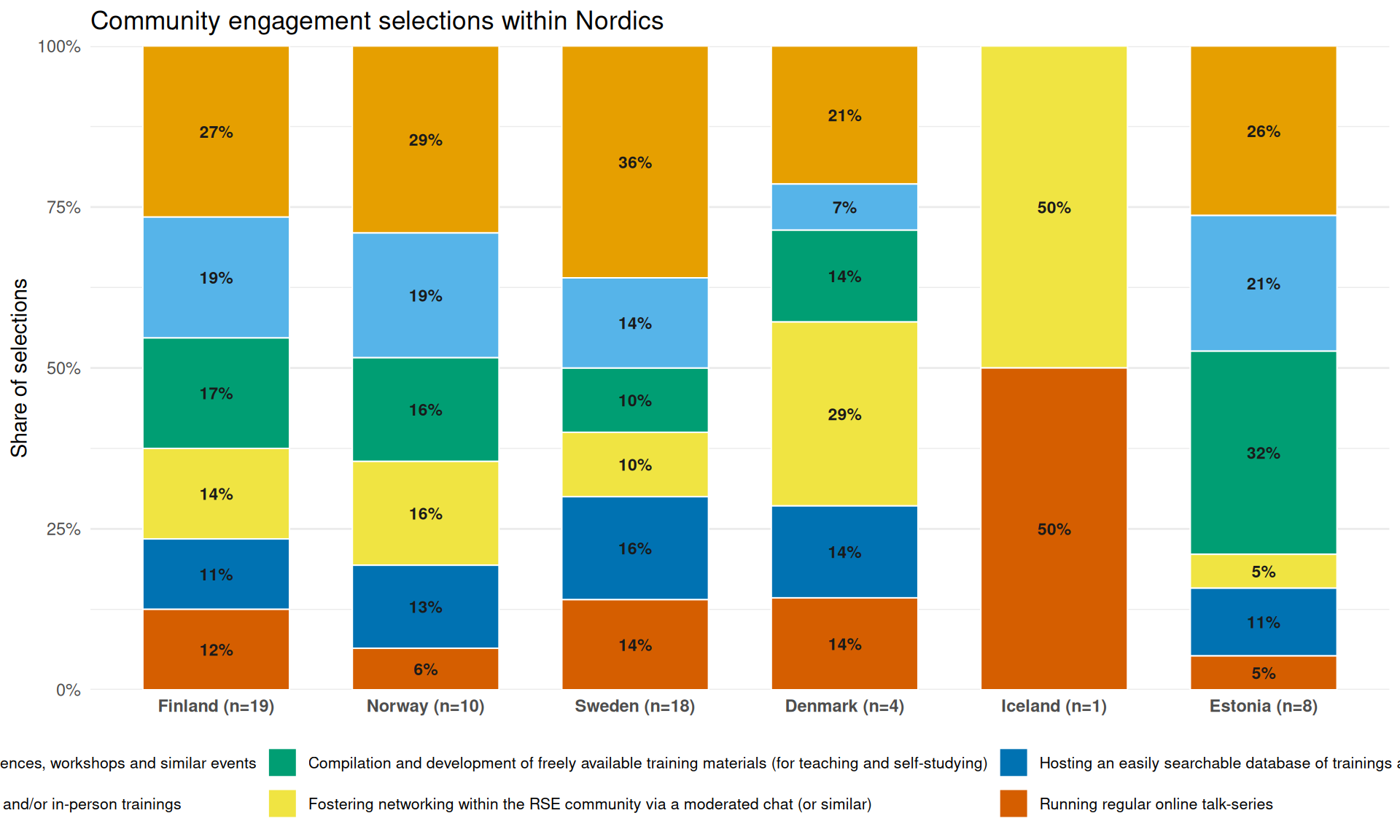
| Community engagement selections within Nordics | ||
| Total respondents: 60. Percentages are within each country. | ||
| Category | Respondents (n) | Percentage (%) |
|---|---|---|
| Estonia (n=8) | ||
| Compilation and development of freely available training materials (for teaching and self-studying) | 6 | 75.0% |
| Organisation of conferences, workshops and similar events | 5 | 62.5% |
| Organisation of online and/or in-person trainings | 4 | 50.0% |
| Hosting an easily searchable database of trainings available through other institutions | 2 | 25.0% |
| Fostering networking within the RSE community via a moderated chat (or similar) | 1 | 12.5% |
| Running regular online talk-series | 1 | 12.5% |
| Iceland (n=1) | ||
| Fostering networking within the RSE community via a moderated chat (or similar) | 1 | 100.0% |
| Running regular online talk-series | 1 | 100.0% |
| Denmark (n=4) | ||
| Fostering networking within the RSE community via a moderated chat (or similar) | 4 | 100.0% |
| Organisation of conferences, workshops and similar events | 3 | 75.0% |
| Compilation and development of freely available training materials (for teaching and self-studying) | 2 | 50.0% |
| Hosting an easily searchable database of trainings available through other institutions | 2 | 50.0% |
| Running regular online talk-series | 2 | 50.0% |
| Organisation of online and/or in-person trainings | 1 | 25.0% |
| Sweden (n=18) | ||
| Organisation of conferences, workshops and similar events | 18 | 100.0% |
| Hosting an easily searchable database of trainings available through other institutions | 8 | 44.4% |
| Organisation of online and/or in-person trainings | 7 | 38.9% |
| Running regular online talk-series | 7 | 38.9% |
| Compilation and development of freely available training materials (for teaching and self-studying) | 5 | 27.8% |
| Fostering networking within the RSE community via a moderated chat (or similar) | 5 | 27.8% |
| Norway (n=10) | ||
| Organisation of conferences, workshops and similar events | 9 | 90.0% |
| Organisation of online and/or in-person trainings | 6 | 60.0% |
| Compilation and development of freely available training materials (for teaching and self-studying) | 5 | 50.0% |
| Fostering networking within the RSE community via a moderated chat (or similar) | 5 | 50.0% |
| Hosting an easily searchable database of trainings available through other institutions | 4 | 40.0% |
| Running regular online talk-series | 2 | 20.0% |
| Finland (n=19) | ||
| Organisation of conferences, workshops and similar events | 17 | 89.5% |
| Organisation of online and/or in-person trainings | 12 | 63.2% |
| Compilation and development of freely available training materials (for teaching and self-studying) | 11 | 57.9% |
| Fostering networking within the RSE community via a moderated chat (or similar) | 9 | 47.4% |
| Running regular online talk-series | 8 | 42.1% |
| Hosting an easily searchable database of trainings available through other institutions | 7 | 36.8% |
14.3 Between Countries